Thursday, 2 June 2011

Ascension Day

File:Ascension2007-04.jpg 

Here's a wee thought for Ascension Day:

"Some part of us is always in the process of healing... the condition of health is not a static state of perfect wellness; it is... a condition of ongoing healing. For example, a possible explanation for the cause of cancer is referred to as the "scanner theory. " This theory holds that various cells in the healthy body routinely become cancerous: but the body remains healthy because within it there is some... mechanism that scans the body for such malignant cells... and proceeds to kill them before they multiply into a growing tumor. What causes cancer then, according to the tbeory, is not a cancerous cell but rather the failure of the "scanner" to detect it... The theory is offered not because it is proven, but because it demonstrates the way in which physicians are increasingly coming to think about disease: that most disease may best be defined as a failure of the healing process."
M. Scott Peck, M.D.

At one level, the Ascension is the ultimate healing.  It heals the great division between the human race and the Divine will, symbolically recounted in the Fall narrative in the book of Genesis.  Yet it has never been a total or complete healing.  Even within the Church the wisdom has always been  "reformandus semper reformandum" - "Reformed and always in need of reform".  Again and again, the Body of Christ, the People of God  have needed healing.  The same is as true today as ever it was.  It needs healing for its attitudes to LGBT people/women/the mentally ill/the poor/non-Caucasian ethnic groups if you take the Liberal line.  It needs healing for its divergence from Scripture on morals and ethics if you take the Conservative approach.  'Twas ever thus!  and in all likelihood will be until the Parousia.  Living with the continued brokenness and dysfunctional nature of the Institutional Church is a pain and sometimes we find we can't put up with it anymore.

A modern collect for Ascension Day helps me to "Keep Buggering On" as Churchill put it:

"O God,
you withdraw from our sight
that you may be known by our love.
Help us to enter the cloud where you are hidden
and surrender all our certainty to the darkness of faith in Jesus Christ.  Amen"
(Janet Morely, as cited in Daily Office SSF)

The concept of faith in Jesus being dark is disturbing - but sometimes living faith is disturbing.  It takes us to encounter our own (and others) darkness.  And through it to healing.  The Apostles went from being Mates of the Messiah to being Friends of the Late, Dead Jesus before experiencing the healing of the Resurrection.  And then they went on to be the Gob Smacked of Galilee today and then the Babbling Linguists of Jerusalem and finally the Confused Council who hacked out a Compromise at Jerusalem. As it still sort of is.  The fact is the Church and Christians are never in "a static state of perfect wellness" - they are always in "a condition of ongoing healing".  That is our vocation.

Tuesday, 31 May 2011

The Visitation of the BVM

An icon of the the Visitation of Mary to Elizabeth.

Here's some info on today's feast.  

The Feast of the Visitation of the Blessed Virgin Mary to Elizabeth is medieval in origin. It started off as a Franciscan devotion and in 1263 Saint Bonaventure recommended it to the Franciscans as a general observance. Him being the Heid Bummer, they agreed! The Franciscan Breviary spread it far and wide. In 1389 the Pope put it in the Roman Calendar, date 2nd July.  It stayed there, the day after the end of the octave of the feast of the Birth of St John the Baptist, who was still in his mother's womb at the time of the Visitation, until 1969 when Pope Paul VI moved it to 31 May, "between the  Annunciation of the Lord (25 March) and the Nativity of St John the Baptist (24 June), so that it would harmonize better with the Gospel story."  Roman Catholics who use a pre-1969 calendar and Anglicans who use the 1662 English BCP celebrate the feast on 2 July - as does the entire Catholic (and Lutheran) Church of Germany, using the post-1969 calendar of Pope Paul VI but with the variations permitted in the German Regional Calendar.

The celebration of this event in the Orthodox Church is more recent (19th century). It was down to Archimandrite Antonin Kapustin, head of the Russian Orthodox Mission in Jerusalem. The Gorneye Convent  in Jerusalem, built on the traditional site of the Meeting of the Virgin Mary) and St. Elizabeth, celebrates this Feast on 30 March. (In the Julian Calendar, 30 March corresponds, until 2099, to the Gregorian Calendar date of 12 April.) . The celebration of the Feast of the Visitation has not yet been accepted by all Orthodox jurisdictions.

Mighty God,
by whose grace Elizabeth rejoiced with Mary
and greeted her as the mother of the Lord:
look with favour on your lowly servants
that, with Mary, we may magnify your holy name
and rejoice to acclaim her Son our Saviour,
who is alive and reigns with you,
in the unity of the Holy Spirit,
one God, now and for ever. Amen

Thursday, 26 May 2011

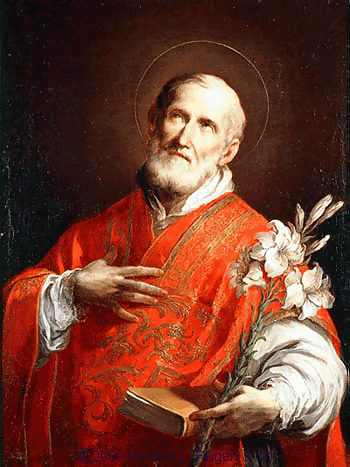
St Phillip Neri

File:FNeri.gif 

It was the feast of the delightful and sympathetic St Phillip Neri today.  I think I'd rather put a pikkie of him up today  than anything to do with the temperamental successor of today's other Saint, Augustine of Canterbury - whom the Venomous Bede reminds us lost the Celtic vote by remaining Prelatically seated, rather than rising to humbly greet his separated brethren with whom he had a few disagreements (like the dating of Easter, how to do your tonsure and how to baptise babies etc).  I can fully understand ++ RW getting ratty under pressure and biffing committees into shape, but it sounds rather nasty, especially when the surviving kin of the author of the leaked memo suggest that the Archiepiscopal nastiness hastened the demise of the cancer afflicted Dean of Southwark.  Not a good news day for Lambeth Palace - so we pray that some of Fra Filippo's gentleness and joy will wing it's way to ABC's lodgings.

Wednesday, 25 May 2011

Back from the "Celtic" (if you only speak English that is) Fringe!

Yes, it has been a while, but it's been busy and I finally got enough kip (doon sooth admittedly) to face trotting out some thoughts!  And it's on Celtic Christianity (WTFeck that is)!

I've been reading around this one a bit recently.  It's rather "in" in God bothering circles these days.  My introduction was via the rigours of a History of Spirituality Course at Furryboots Yooni back in the days of good Bishop Elphinstone where we learnt about a discipline of  having a soul friend, standing up to yir oxters in the Sound of Iona reciting the Psalter when you'd been bad and rolling in nettles when the felt any urges that might worry the sheep!  Nae tree huggin like!  I then spent time at Iona Abbey and discovered the modern form with the shared economic discipline of George MacLeod's Milites Christi.  Which none of much of the current stuff seems to keep in mind. I read some "Liturgies from Lindisfarne" recently which were trite, tree hugging, written in Amerikan and kept attributing The Jesus Prayer to a middle aged Anglican male cleric!

My doubts were amply confirmed by 2 critical volumes.  One by Rosemary Power (Iona Community)"The Celtic Quest: A Contemporary Spirituality" and the other by Donald Meek (former Prof of Heedrum-Hodrum Studies at Embra and Furryboots Unis, son of the Tiree Baptist Manse and native Gaelic speaker - or a REAL Celtic Christian who speaks the lingo!) "The Quest for Celtic Christianity".  Both blast the current Celtic Christianity industry as being dubiously connected to the real thing, mainly produced by middle aged, English male clergy on the working fringe of the institutional Church and all aimed not at the genuinely un-churched but those who feel distanced from the institution and want an alternative structure where the centre of power is redistributed (one imagines to them and their pals in the 1st instance).  I generally agree with the critics.  I see the value of "Celtic Christianity" in as much as it refreshes those for whom Flat Church has gone stale.  But I think it's lack of rootedness in sold Christian tradition means it's a very Post-Modern thing which will fade into insignificance within a few decades - rather like Anglican Papalism has.  Aye right, fine if ye like it - whaur's my copy of "The Cloud of Unknowing" gone, that'll last better!

Monday, 2 May 2011

St George's Day