Tuesday, 31 January 2012

St Bride's Day

File:Saint Brigid's cross.jpg

St Bride's Cross

One of the great Irish saints, and patron of those powerful Scottish Lords, the Douglas's, Bride was born at Faughart near Dundalk, County Louth, Ireland. Faughart Church was founded by Saint Moninne in her honour and the old well, adjoining the ruined church there still attracts pilgrims.Because of the dubious historicity of the earliest accounts of her life, there is mucho debate as to the authenticity of her biographies. Allegedly her parents were Dubhthach, a pagan chieftain of Leinster, and Brocca, a Christian Pict and slave, baptised by Saint Patrick. Some accounts suggest that her father was from Lusitania, kidnapped by Irish pirates and brought to Ireland to as a slave, rather like Saint Patrick. I like the idea of her humbler origins myself.  A freed slave made mighty by the overshadowing of the Holy Spirit.  Fitting for the woman know as "the Mary of the Gaels".

St Bride was famous for her generosity to the poor. According to one tale, as a child, she once gave away her mother's entire store of butter. The butter was then replaced in answer to her prayers.  She was allegedly "accidentally" ordained bishop, by one or other of the bishops Mel (d. 487) or Mac-Caille (d. c.489), probably being in Mág Tulach (Fartullagh, Co. Westmeath). Mel also granted her abbatial powers. She followed Saint Mel into the Kingdom of Teathbha (sections of modern Meath, Westmeath and Longford) in about 468.

Bride's small oratory at Kildare became a centre of religion and learning and eventually a cathedral city. She founded two monastery's, one for men, and the other for women, and appointed Saint Conleth as spiritual pastor of them. It has been frequently (mis) stated that she gave canonical jurisdiction to Saint Conleth as Bishop of Kildare, but, as Archbishop Healy points out, she simply "selected the person to whom the Church gave this jurisdiction", and her biographer tells us distinctly that she chose Saint Conleth "to govern the church along with herself". Thus, for centuries, Kildare was ruled by a double line of abbot-bishops and of abbesses, the Abbess of Kildare being regarded as superior general of the monasteries in Ireland.

Bride also founded a school of art, metal work and illumination, over which Conleth presided. The Kildare scriptorium produced the Book of Kildare, highly praised by Giraldus Cambrensis, but which has been missing since the Reformation. According to Giraldus, nothing that he had ever seen was at all comparable to the book, every page of which was gorgeously illuminated, and he concludes by saying that the interlaced work and the harmony of the colours left the impression that "all this is the work of angelic, and not human skill".

Her friendship with Saint Patrick is attested by the following paragraph from the Book of Armagh:  "Between Patrick and Brigid, the columns of the Irish, there was so great a friendship of charity that they had but one heart and one mind. Through him and through her Christ performed many miracles". At Armagh there was a "Templum Brigidis" - namely the little abbey church known as "Regles Brigid", which contained some relics of the saint, destroyed in 1179.

Bride was interred at the right of the high altar of Kildare Cathedral, and a costly tomb was erected over her "Adorned with gems and precious stones and crowns of gold and silver." Over the years her shrine became an object of veneration for pilgrims, especially on her feast day, February 1. About the year 878, owing to the Scandinavian raids, Brigit's relics were taken to Downpatrick, where they were interred in the tomb of Patrick and Columba. The relics of the three saints were discovered in 1185, and on June 9 of the following year were re interred in Down Cathedral.

File:KildareCathedral.JPG
St Bride's Cathedral Kildare.

Almighty God,
by whose grace St Bride, kindled with the fire of your love,
became a burning and a shining light in the Church:
inflame us with the same spirit of discipline and love,
that we may ever walk before you as children of light;
through Jesus Christ your Son our Lord,
who is alive and reigns with you,
in the unity of the Holy Spirit,
one God, now and for ever.  Amen.

Wednesday, 25 January 2012

The Conversion of St Paul

File:Michelangelo Merisi da Caravaggio - The Conversion of St. Paul - WGA04135.jpg
Caravaggio, The Conversion of St Paul,Odescalchi Balbi Collection, Rome

I love the artwork (well it is my favourite, Caravaggio) but have never especially raved about the Conversion of Saul into Paul. It is striking and wonderful that God was able to use and transform the great persecutor into an instrument of mission, but in all honesty, I'm not fond of St Paul.  I know he's terribly significant and important etc, but he's never really been one of my faves..  St John Chrysostom (a saint of whom I am rather more fond) preached this about him:

  "The most important thing of all to him, however, was that he knew himself to be loved by Christ. Enjoying this love, he considered himself happier than anyone else; were he without it, it would be no satisfaction to be the friend of principalities and powers. He preferred to be thus loved and be the least of all, or even to be among the damned, than to be without that love and be among the great and honoured.
 
  To be separated from that love was, in his eyes, the greatest and most extraordinary of torments; the pain of that loss would alone have been hell, and endless, unbearable torture.
  So too, in being loved by Christ he thought of himself as possessing life, the world, the angels, present and future, the kingdom, the promise and countless blessings. Apart from that love nothing saddened or delighted him; for nothing earthly did he regard as bitter or sweet."

Centred on the love of God. That is ultimately what we who are Christians all ought to aspire to be.

Almighty God,
who caused the light of the gospel
to shine throughout the world
through the preaching of your servant Saint Paul:
grant that we who celebrate his wonderful conversion
may follow him in bearing witness to your truth;
through Jesus Christ your Son our Lord,
who is alive and reigns with you,
in the unity of the Holy Spirit,
one God, now and for ever. Amen.

Monday, 23 January 2012

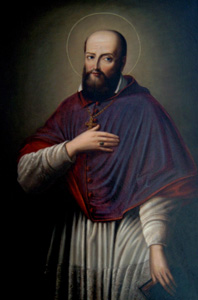
St Francis de Sales.


Coat of arms of St Francis de Sales

St Francis de Sales is a great saint.  Some quotations give a flavour of his gentle spirituality.

There are no galley-slaves in the royal vessel of divine love—every man works his oar voluntarily!

You learn to speak by speaking, to study by studying, to run by running, to work by working ; and just so you learn to love God and man by loving. All those who think to learn in any other way deceive themselves.

Have patience with every one, but especially with yourself. (How very 12 step!)
Quoted by Bishop Jean-Pierre Camus in The Spirit of Saint Francis de Sales.

I like this from his "Introduction to the Devout Life":

"I say that devotion must be practised in different ways by the nobleman and by the working man, by the servant and by the prince, by the widow, by the unmarried girl and by the married woman. But even this distinction is not sufficient; for the practice of devotion must be adapted to the strength, to the occupation and to the duties of each one in particular.

  Moreover, just as every sort of gem, cast in honey, becomes brighter and more sparkling, each according to its colour, so each person becomes more acceptable and fitting in his own vocation when he sets his vocation in the context of devotion. Through devotion your family cares become more peaceful, mutual love between husband and wife becomes more sincere, the service we owe to the prince becomes more faithful, and our work, no matter what it is, becomes more pleasant and agreeable."

Grant, Lord, that in the service of our fellow-men
we may always reflect your own gentleness and love,
and so imitate Saint Francis de Sales,
whom you made all things to all men for the saving of souls.
through our Lord Jesus Christ, your Son,
who lives and reigns with you in the unity of the Holy Spirit,
God for ever and ever.  Amen.


St Francis de Sales, pray for us.

Sunday, 22 January 2012

Gawd help America!

Newt Gingrich set his sights Sunday on Florida after a stunning win in South Carolina's presidential primary

The US Republican Presidential candidate selection process is rather fun (!) - at any rate to an ex-political-hack such as myself.   http://uk.news.yahoo.com/u-republicans-romney-gingrich-vie-south-carolina-win-000020425.html To lift a quote from the article: "Some Florida voters were delighted by Gingrich's rise.  "We are for Gingrich all the way," said Ada Rodriguez, 75, a real estate broker. "Obama is a socialist. He is the same as Castro," referring to Cuban dictator Fidel Castro, the enemy of many in Florida's Cuban exile community."

If dear Ada (doubtless, an awfy nice wee auld wifie and all that) really thinks that the current occupant of yon place on Pennsylvania Ave. which the Royal Marines burnt in 1812 is a Commie, then she's a) never read Marx b) or Dorothy Day of the Catholic Worker movement c) has no idea what Fidel Castro has actually done (both good and bad) and d) would doubtless see David Cameron as some sort of mad pinko.  In short, many of the most quotable in both politics (and indeed religion) are basically theoretically illiterate in the particular field on which they pronounce.  Trouble is, they can vote for and create an outcome that messes up the lives of billions who can't really act against their dafter ideas.  That said, you really can't ban the incurably biased or stupid from having a vote.  That would be undemocratic. And a bad thing.

let's just hope the US electors (historically capable of picking great presidents like FDR or Teddy Roosevelt and utter disgraces like Warren Harding) can go for someone sensible from whatever party they as a majority favour.  Bampots with nukes are a seriously bad idea.

Saturday, 21 January 2012

Freedom? It's a dangerous thing.

The press reports about the successful prosecution of a number of leaflet distributors in Derby for passing out anti-gay leaflets which alluded to the possible desirability of  the death penalty for LGBT people (see http://uk.news.yahoo.com/muslims-guilty-over-gay-leaflets-152353818.html ) make me both pleased (that the law has acted to defend LGBT people from hatred) and thoughtful.  The fact that all of the individuals concerned are Muslims is almost entirely irrelevant at one level - plough any set of sacred Scriptures (Christian, Jewish Islamic, Buddhist or Hindu) and you will find anti-Gay or potentially anti-gay material. Of course there is not the slightest doubt in my mind that they and their supporters will see themas martyrs like St Vincent here.

  File:Vicente de Zaragoza anonymous painting XVI century.jpeg 

But there is always the slight worry in my mind that any such legal action against faith based demonstrations in what might be called the political sphere (and LGBT rights are a matter of politics) could later be used for a more general repression of the voice of the Faiths when they are critical of current political trends or developments.   legitimate faith inspired dissent has a honourable place and a decent one in our political life.  For year CND was led by outspoken and faith inspired clergy  like Canon John Collins (below)

File:Canoncollins.jpg 

and Monsignor Bruce Kent.  So, whilst I'm glad the leaflet distributors were made to feel the full weight of a wise law, let us never forget that there should always be freedom for those who religious convictions compel them to dissent from the prevailing viewpoint as long as it doesn't advocate violence.