Showing posts with label Advent thoughts.. Show all posts

Friday, 23 December 2011

O Emmanuel

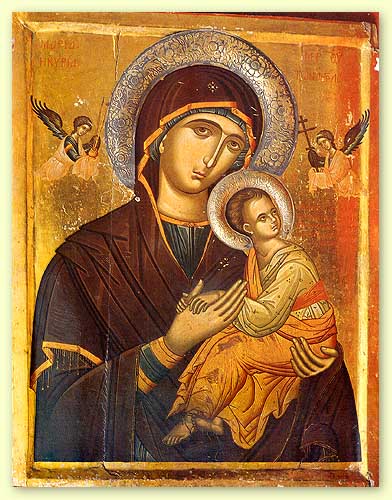
File:Mary16thC.jpgIcon of the Blessed Virgin Mary holding the child Immanuel (16th cent. St. Catherine's Monastery, Mount Sinai).
The Latin antiphon is:
O Emmanuel, Rex et legifer noster,
exspectatio Gentium, et Salvator earum:
veni ad salvandum nos, Domine, Deus noster.
or in English:
O Emmanuel, our king and our lawgiver,
the hope of the nations and their Saviour:
Come and save us, O Lord our God.
It's based on one of the most familiar of the Advent/Christmas readings:

"Therefore the Lord himself will give you a sign. Look, the young woman is with child and shall bear a son, and shall name him Immanuel." Isaiah 7:14

God is with us which is a scary and comforting thought.  Scary because it means the Holy of Holies is among us, dwelling in an earthly tabernacle of frail flesh.  Comforting because it means that God utterly identifies with us - adopts us - and grants us the Kingdom as a gift.  Great, eh?

Thursday, 22 December 2011

O Rex Gentium

File:Hubert van Eyck 023.jpg 
Christ the King, a detail from the Ghent Altarpiece by Jan van Eyck.

The Latin antiphon is:
O Rex Gentium, et desideratus earum,
lapisque angularis, qui facis utraque unum:
veni, et salva hominem,
quem de limo formasti.
which is in English:
O King of the nations, and their desire,
the cornerstone making both one:
Come and save the human race,
which you fashioned from clay.
"For a child has been born for us, a son given us; authority rests upon his shoulders; and he is named Wonderful Counsellor, Mighty God, Everlasting Father, Prince of Peace." Isaiah 9:6

"He shall judge between the nations, and shall arbitrate for many peoples; they shall beat their swords into ploughshares, and their spears into pruning-hooks; nation shall not lift up sword against nation, neither shall they learn war anymore." Isaiah 2:4

If you are going to acknowledge Christ as King of the Nations, then using a prayer from one of them may not be a bad thing.

"May all beings everywhere plagued with sufferings of body and mind quickly be freed from their illnesses. May those frightened cease to be afraid, and may those bound be free. May the powerless find power, and may people think of befriending one another. May those who find themselves in trackless, fearful wildernesses - the children, the aged, the unprotected - be guarded by beneficent celestials, and may they swiftly attain Buddhahood."  Buddhist prayer

I can reconcile this one with my faith as the "beneficent celestials" to me are "angels and archangels and the whole company of heaven" . As to "attaining Buddahood" - well, being perfected in Christ through his Incarnation, Death and Resurrection is achieving perfect fulfilment or Buddahood.  If Christ is the Cornerstone, then he draws all nations and faith to himself and perfects in due course all our errors and misunderstandings.  or Anonymous Christianity - the theological idea that declares that those who have never heard the Gospel might be saved.

You can find traces of this idea in the Vatican 2 document "Lumen Gentium", which states that those "who no fault of their own, do not know the Gospel of Christ or His Church, but who nevertheless seek God with a sincere heart, and moved by grace, try in their actions to do His will as they know it through the dictates of their conscience – those too may achieve eternal salvation". (LG para 15)

The German Jesuit theologian Karl Rahner's put it more forcefully: Non-Christians could have "in [their] basic orientation and fundamental decision, accepted the salvific grace of God, through Christ, although [they] may never have heard of the Christian revelation." 

 King of the nations, bring ALL your children into the fullness of life that is your will for us all.  Amen.

Wednesday, 21 December 2011

O Oriens


"Gero crucifix“, late 10th century, Cologne Cathedral, Germany
 In Latin the antiphon is:
O Oriens,
splendor lucis aeternae, et sol justitiae:
veni, et illumina sedentes in tenebris, et umbra mortis.
or in English:
O Morning Star,
splendour of light eternal and sun of righteousness:
Come and enlighten those who dwell in darkness and the shadow of death.
(NB: A literal translation of the Latin is "O Rising Sun", but the poetic "O Morning Star" is often preferred.)

Isaiah had written:

"The people who walked in darkness have seen a great light; those who lived in a land of deep darkness—on them light has shined." Isaiah 9:2

Light from the East.  The direction of the rising Sun, the reason why some of us still prefer to face east when celebrating the Eucharist .  That light which is coming - the Light of the World.File:Hunt Light of the World.jpg                        
This poem offers some food for reflection:
O Oriens Paradiso XXX; 61
First light and then first lines along the east
To touch and brush a sheen of light on water
As though behind the sky itself they traced
The shift and shimmer of another river
Flowing unbidden from its hidden source;
The Day-Spring, the eternal Prima Vera.
Blake saw it too. Dante and Beatrice
Are bathing in it now, away upstream…
So every trace of light begins a grace
In me, a beckoning. The smallest gleam
Is somehow a beginning and a calling;
“Sleeper awake, the darkness was a dream
For you will see the Dayspring at your waking,
Beyond your long last line the dawn is breaking”

Malcolm Guite

May the light ignite in our hearts a new sense of being called to worship, serve and love.

Tuesday, 20 December 2011

O Clavis David

Samuel anointing David
The antiphon for today is:
O Clavis David, et sceptrum domus Israel;
qui aperis, et nemo claudit;
claudis, et nemo aperit:
veni, et educ vinctum de domo carceris,
sedentem in tenebris, et umbra mortis.
which is in English:
O Key of David and sceptre of the House of Israel;
you open and no one can shut;
you shut and no one can open:
Come and lead the prisoners from the prison house,
those who dwell in darkness and the shadow of death.
It draws on:

"I will place on his shoulder the key of the house of David; he shall open, and no one shall shut; he shall shut, and no one shall open." Isaiah 22:22

"His authority shall grow continually, and there shall be endless peace for the throne of David and his kingdom. He will establish and uphold it with justice and with righteousness from this time onwards and for evermore." Isaiah 9:7

"To open the blind eyes, to bring out the prisoners from the prison, and them that sit in darkness out of the prison house." Isaiah 42:7.

Again the promise of liberation and freedom.   This paraphrase from (By A.C.A. Hall, Bishop of Vermont. A.R. Mowbray & Co., n.d. but c. 1914) gives food for reflection:

O Lord Jesu Christ, to Whom is given the throne and sceptre of David Thy father over the house of Israel,
that Thou mighest extend his kingdom over all peoples:
Thou didst come in our nature, as the Son of man forgiving sins, dispelling sickness and loosing bonds:
to Thee now is committed all authority in heaven and on earth,
and the powers of hell cannot withstand Thy word:
Come, we pray Thee, by Thy grace, 
and through the instrumentality of Thy Church,
to loosen the prisoner from the chains of sin,
to enlighten with the glad tidings of Thy word all who sit in darkness and the shadow of death,
that they may rejoice in the deliverance which Thou hast wrought.

It elliptically touches on the "political" impact of the Incarnation. But today, inspired by the likes of Archbishops Desmond Tutu and Trevor Huddleston, we are more likely to be pointed in our Christian critique of political policies.  and rightly so.  Perhaps it's a day to pray that the shadow of the Stalinist prison house will begin to shorten in North Korea?

Sunday, 18 December 2011

O Radix Jesse


File:Master of James IV of Scotland getty Ms ludwig IX 18 f65 1510-20.jpg 

Tree of Jesse from the Master of James IV of Scotland, Flemish, Bruges and Ghent or Mechelen, 1510 - 1520. Tempera colours, gold, and ink on parchment 9 1/8 x 6 9/16 in. MS. LUDWIG IX 18, FOL. 65

The antiphon for today is:
O Radix Jesse, qui stas in signum populorum,
super quem continebunt reges os suum,
quem Gentes deprecabuntur:
veni ad liberandum nos, jam noli tardare.
or in English:
O Root of Jesse, standing as a sign among the peoples;
before you kings will shut their mouths,
to you the nations will make their prayer:
Come and deliver us, and delay no longer.
Isaiah had written: "A shoot shall come out from the stock of Jesse, and a branch shall grow out of his roots." Isaiah 11:1 and "On that day the root of Jesse shall stand as a signal to the peoples; the nations shall inquire of him, and his dwelling shall be glorious." Isaiah 11:10

Jesse was the father of King David, and Micah had prophesied that the Messiah would be of the house and lineage of David and be born in David’s city, Bethlehem (Micah 5:2). 

Radical to think that it will be a poor Jewish boy from the butt end of the Roman Empire (Palestine was not a sought after posting) who the power brokers will belt up before and that he will be (as he is) the one to whom prayer is offered in one form or another in nearly every nation of the world.  Oh dear - maybe the bankers ain't gonna fare so well on the day of judgement?  Or the politicians?

Monday, 28 November 2011

Another Credo?


Icon depicting Emperor Constantine (centre) and the Fathers of the First Council of Nicaea (325) as holding the Niceno–Constantinopolitan Creed of 381

Another Credo?  The world and indeed the Church is full of them.  Every Tom, Dick and Harriet with an interest in liturgy and an agenda to run can hash one together and proclaim it thus.  A Feminist Creed, a Gay Creed a Socialist Creed etc, etc,etc..... I don't see any of them as replacements for the Ecumenical Creeds of the Undivided Church but to reflect on them every so often (or even to recite them in Church) can sharpen our understanding of the implications of the faith we profess.  Like this one - Dorothy Sollee's German Creed:

I believe in God
who didn’t create a world
full of things that are the same,
who doesn’t rule in accordance with eternal laws
which are unchangeable
nor under the natural order
of poor and rich,
experts and uninformed
rulers and those who depend on their mercy.

I believe in God
who supports the protests of the living
and the change of all conditions
through our work
and through our politics.

I believe in Jesus Christ who was right when he,
as an ‘individual who can’t change anything’
just like us worked for the change of all conditions
and who perished in so doing.
Compared with him I realise
how our intelligence cripples
and our fantasy stifles
our efforts are wasted
because we don’t live like he did.
Every day I am afraid
that He died in vain
because he is buried in our churches
because we have betrayed His revolution
in obedience and fear of authorities.

I believe in Jesus Christ
who rises from the dead in our life
so that we can become free
from prejudice and arrogance
from fear and hatred
and drive His revolution
towards his reign.

I believe in the Spirit
that came into this world with Jesus
to the community of all nations
and our responsibility for what
becomes of our world,
a valley full of lamentation, hunger and violence
or the city of God.

I believe in the just peace that can be created
in the possibility of a meaningful life
for all people in the future of this world of God.

In Advent we prepare for the return of the Prince of Peace. For the coming of the the Kingdom that is Justice and Peace. We pray, we hope. And hopefully we act.  We act justly. We attempt, at least in a small way, to re-order our own little bit of the kingdom in a more peaceful and just way.  We do our bit.  If nothing else, we put one more brick in the wall that reaches to Heaven.  And in that hopeful building, we show what we really believe.

Sunday, 29 November 2009

Newman on the Coming of Christ

We too are looking out for Christ's coming,—we are bid look out,—we are bid pray for it; and yet it is to be a time of judgment. It is to be the deliverance of all Saints from sin and sorrow for ever; yet they, every one of them, must undergo an awful trial. How then can any look forward to it with joy, not knowing (for no one knows) the certainty of his own salvation? And the difficulty is increased when we come to pray for it,—to pray for its coming soon: how can we pray that Christ would come, that the day of judgment would hasten, that His kingdom would come, that His kingdom may be at once,—may come on us this day or tomorrow,—when by so coming He would be shortening the time of our present life, and cut off those precious years given us for conversion, amendment, repentance and sanctification? Is there not an inconsistency in professing to wish our Judge already come, when we do not feel ourselves ready for Him? In what sense can we really and heartily pray that He would cut short the time, when our conscience tells us that, even were our life longest, we should have much to do in a few years?

These opposite duties of fearing yet praying to have the sight of Christ are not necessarily inconsistent with each other. Why we should fear it, is not strange. Surely when a man gets himself steadily to contemplate a state of things beyond this life, he is in the way to be overpowered by the thoughts which throng upon him. How dreadful to the imagination is every scene of that unknown hereafter!

When we pray for the coming of Christ, we do but pray in the Church's words, that He would "accomplish the number of his elect and would hasten His kingdom." That is, we do not pray that He would simply cut short the world, but... that He would make time go quicker, and the wheels of His chariot speed on. Before He comes, a certain space must be gone over; all the Saints must be gathered in; and each Saint must be matured. Not a grain must fall to the ground; not an ear of corn must lose its due rain and sunshine. All we pray is, that He would please to crowd all this into a short space of time; that He would "finish the work and cut it short in righteousness," and "make a short work upon the earth;" that He would accomplish,—not curtail, but fulfil,—the circle of His Saints, and hasten the age to come without disordering this.

I have spoken of coming to God in prayer generally; but if this is awful, much more is coming to Him in the Sacrament of Holy Communion; for this is in very form an anticipation of His coming, a near presence of Him in earnest of it. And a number of men feel it to be so; for, for one reason or another, they never come before Him in that most Holy Ordinance, and so deprive themselves of the highest of blessings here below. Thus their feeling is much the same as theirs would be, who from fear of His coming, did not dare look out for it. They indeed who are in the religious practice of communicating, understand well enough how it is possible to feel afraid and yet to come. Surely it is possible, and the case is the same as regards the future day of Christ. You must tremble, and yet pray for it. We have all of us experienced enough even of this life, to know that the same seasons are often most joyful and also most painful. The joy does not change the grief, nor the grief the joy, into some third feeling; they are incommunicable with each other, both remain, both affect us.

Or consider the mingled feelings with which a son obtains forgiveness of a father,—the soothing thought that all displeasure is at an end, the veneration, the love, and all the undescribable emotions, most pleasurable, which cannot be put into words,—yet his bitterness against himself. Such is the temper in which we desire to come to the Lord's table; such in which we must pray for His coming; such in which His elect will stand before Him when He comes.

A slab of Cardinal Newman! Preached in his Anglican days. Advent is both a joy and a mystery. Waiting yet also trembling. Properly observed, there is a solemnity to this season, which while it lacks the austerity and even rigour of Lent, also calls us to a reflectiveness which is quite different in feel from the Lenten season. The reflectiveness springs in part from the thought of the last things and in part from the closing of the calendar year. We muse and consider both endings and beginings, hopes for the future and sorrow for that which is past. And we reflect (hopefully) with a sense of thankfullness and anticipation. Newman knew well that sense of mixed feelings: his parting from the old security of life as an Anglican Oxford Don into the new adventure of life as a Roman Catholic Oratorian. The pain of leaving friends like Keble and Pusey as he followed God's call and his destiny. He is a good and honest companion on the journey and his words still ring true.