Showing posts with label Christian unity. Show all posts

Friday, 18 January 2013

Unity and Harmony

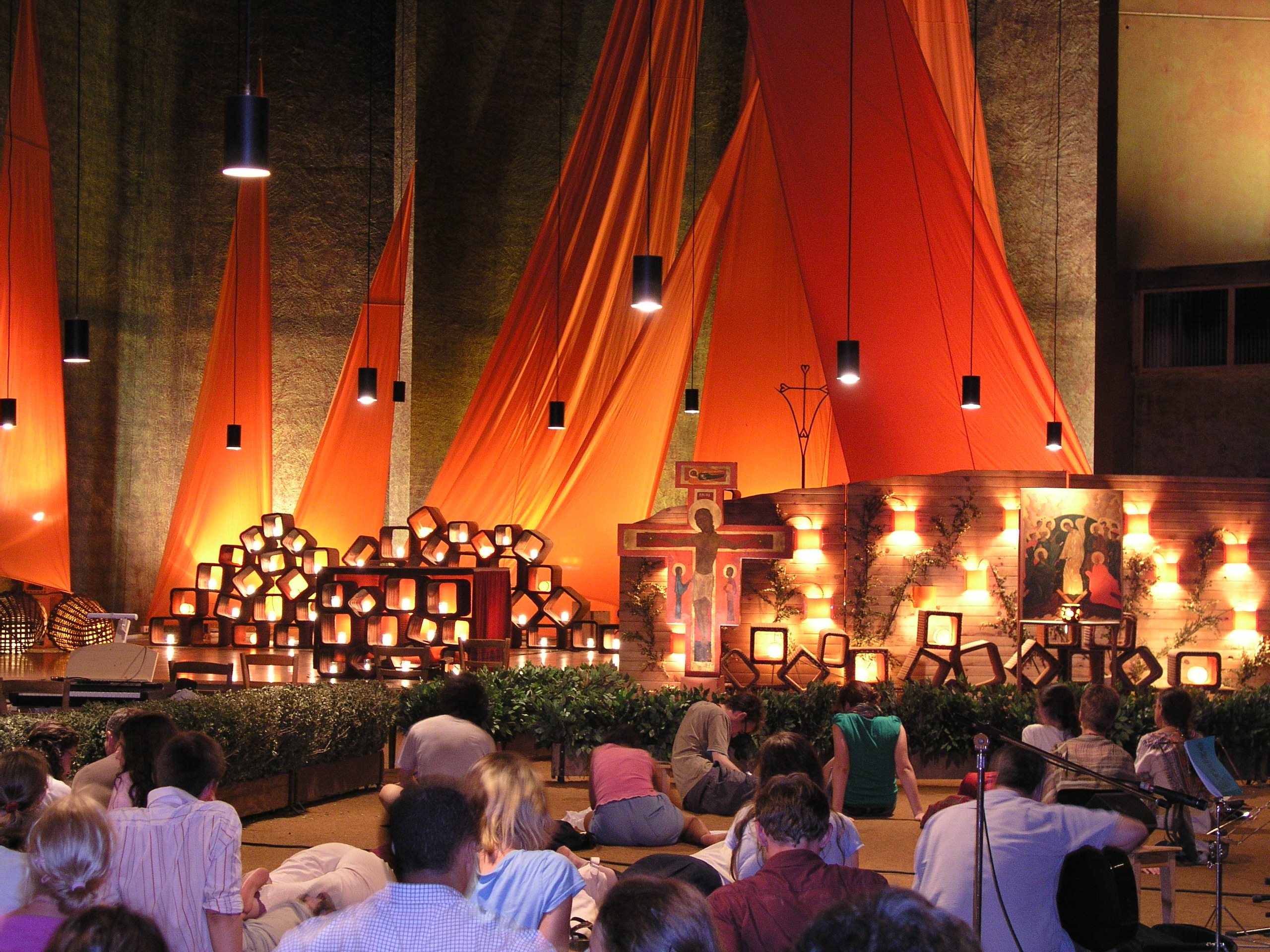
File:Taizé prayer.JPG

Unity at Taize.

Here's a thought for the modern age from the pre-modern age:

From a Discourse Against the Pagans by Saint Athanasius.
The Word creates a divine harmony in creation.
 
"In the beginning was the Word, and the Word was with God, and the Word was God. All things were made through him, and without him nothing was made. In these words John the theologian teaches that nothing exists or remains in being except in and through the Word.
 
Think of a musician tuning his lyre. By his skill he adjusts high notes to low and intermediate notes to the rest, and produces a series of harmonies. So too the wisdom of God holds the world like a lyre and joins things in the air to those on earth, and things in heaven to those in the air, and brings each part into harmony with the whole. By his decree and will he regulates them all to produce the beauty and harmony of a single, well-ordered universe. While remaining unchanged with his Father, he moves all creation by his unchanging nature, according to the Father’s will. To everything he gives existence and life in accordance with its nature, and so creates a wonderful and truly divine harmony.
To illustrate this profound mystery, let us take the example of a choir of many singers. A choir is composed of a variety of men, women and children, of both old and young. Under the direction of one conductor, each sings in the way that is natural for him: men with men’s voices, boys with boys’ voices, old people with old voices, young people with young voices. Yet all of them produce a single harmony. Or consider the example of our soul. It moves our senses according to their several functions so that in the presence of a single object they all act simultaneously: the eye sees, the ear hears, the hand touches, the nose smells, the tongue tastes, and often the other parts of the body act as well as, for example, the feet may walk.
 
Although this is only a poor comparison, it gives some idea of how the whole universe is governed. The Word of God has but to give a gesture of command and everything falls into place; each creature performs its own proper function, and all together constitute one single harmonious order."
 
The sense of divine harmony - the choir of creation - strikes me as being far from incompatible with modern science.  From what little I understand of quantum physics, it seems perfectly reasonable to synthesise the two.  Richard Dawkins might see it as unnecessary, but frankly that doesn't bother me.
 
Harmony is what lies at the heart of the Week of Prayer for Christian Unity which we are in at the moment.  The harmony of different insights and emphases that makes the true and full unity of the Body of Christ.  May that harmony be our aim and goal this week.  Not just for this week, but for the ongoing life of the Church.

Monday, 13 February 2012

Anglicans and Orthodoxy

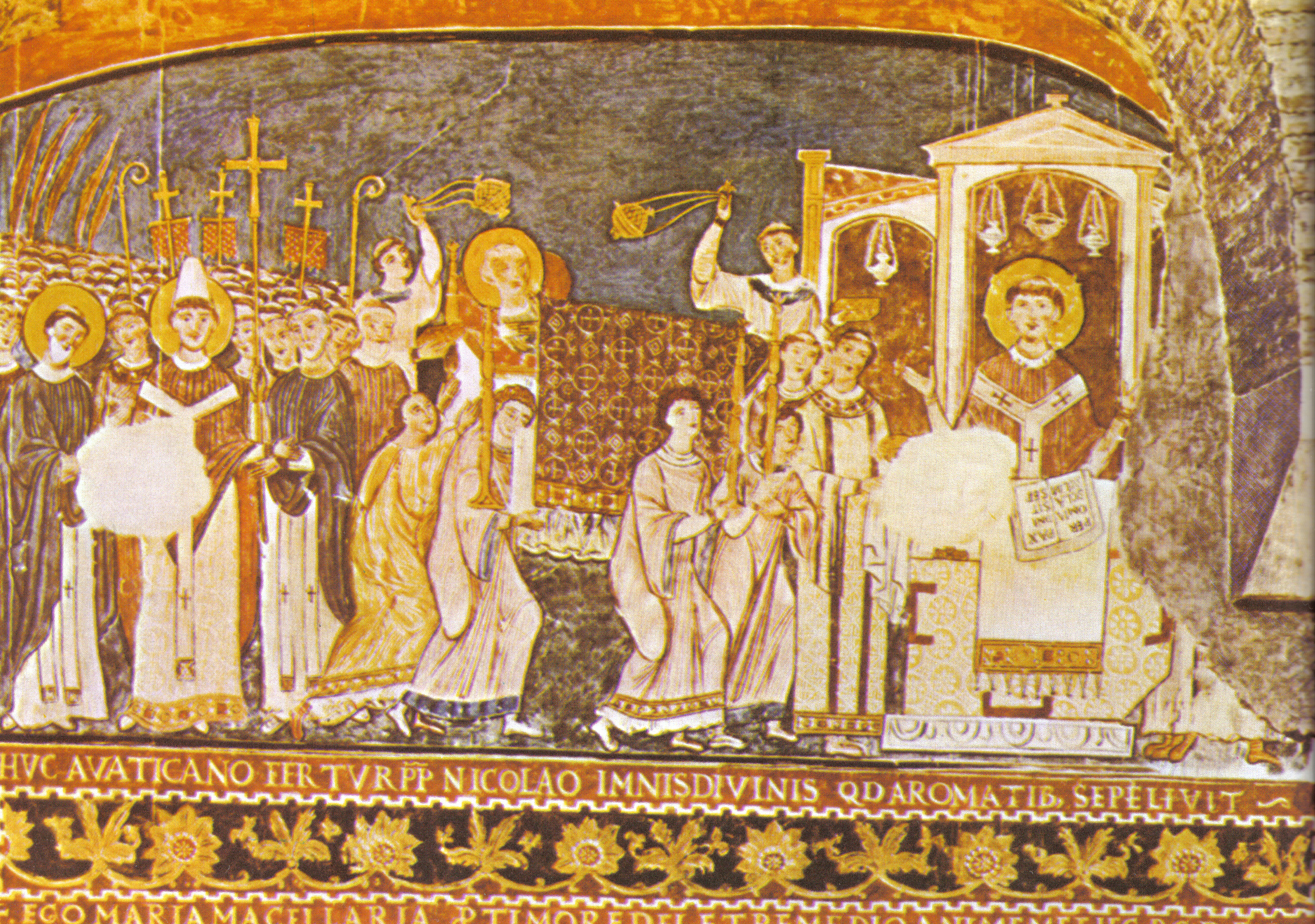
File:San clemente fresco.jpg
SS Cyril & Methodius, 11th Century fresco, Basilica of S Clemente Rome

Here is some interesting ecumenical news for fans of unity between Churches: http://www.christiantoday.com/article/anglicans.and.orthodox.churches.formalise.ecumenical.relationship/29274.htm  

The Oriental Orthodox are the old "Monophysite"  (now referred to as "Miaphysite") Churches.  However, back in 1984 the Pope and the Patriarch noted that  the Chalcedonian schism was not seen as terribly relevant, and they issued this common statement:

"The confusions and schisms that occurred between their Churches in the later centuries, they realise today, in no way affect or touch the substance of their faith, since these arose only because of differences in terminology and culture and in the various formulae adopted by different theological schools to express the same matter. Accordingly, we find today no real basis for the sad divisions and schisms that subsequently arose between us concerning the doctrine of Incarnation. In words and life we confess the true doctrine concerning Christ our Lord, notwithstanding the differences in interpretation of such a doctrine which arose at the time of the Council of Chalcedon."


This Anglican /Oriental Orthodox agreement is particularly good news, given that tomorrow is the Feast of SS Cyril and Methodius, who were the great missioners of the Slavs, engaged in inter faith dialogue with Islam (albeit with a nasty anti-Jewish slant) or to quote Wikipedia: "Cyril's mastery of theology and command of both Arabic & Hebrew made him eligible for his first mission. He was sent to the Abbasid Caliph to discuss the principle of the Holy Trinity with Arab theologians, and to improve relations between the Caliphate and the Empire.
Cyril took an active role in relations with the other two monotheistic religions, Islam and Judaism. He penned fiercely anti-Jewish polemics, perhaps connected with his mission to the Khazar Khaganate, located near the Sea of Azov and  ruled by a Jewish king who allowed Jews, Muslims, and Christians to live peaceably side by side. He also undertook a mission to the Arabs with whom, according to the "Vita", he held discussions. He is said to have learnt the Hebrew, Samaritan, and Arabic languages during this period.

The second mission (860), requested by the Byzantine Emperor and the Patriarch Photius, was a missionary expedition to the Khazar Khaganate in order to prevent the expansion of Judaism there. This mission was unsuccessful, as later the Khagan imposed Judaism on his people as the national religion."  Cyril & Methodius are patron saints of Ecumenicism, especially between the Orthodox and Roman Catholic Church Churches and also of Bulgaria, the Republic of Macedonia, the Czech Republic, Slovakia and Europe. Europe.  Give thanks and pray for more unity between Christians.

Lord of all,
who gave to your servants Cyril and Methodius
the gift of tongues to proclaim the gospel to the Slavs:
make your whole Church one as you are one
that all Christians may honour one another,
and east and west acknowledge
 one Lord, one faith, one baptism,
and you, the God and Father of all;
through Jesus Christ your Son our Lord,
who is alive and reigns with you,
in the unity of the Holy Spirit,
one God, now and for ever.  Amen


Wednesday, 18 January 2012

Christian Unity Week

wcc logo
Christian Unity has long been a passion of mine (despite my intense detestation of the typical Presbyterian monologue services I all too often have had to endure in its furtherance!)  My personal theology is that of that brilliant and appropriate collect from 1929 Scottish Prayer Book for the unity of all Christian people: 

O GOD, the Father of our Lord Jesus Christ, our only Saviour, the Prince of Peace: Give us grace seriously to lay to heart the great dangers we are in by our unhappy divisions. Take away all hatred and prejudice, and whatsoever else may hinder us from godly union and concord: that, as there is but one Body, and one Spirit, and one hope of our calling, one Lord, one Faith, one Baptism, one God and Father of us all, so we may henceforth be all of one heart, and of one soul, united in one holy bond of truth and peace, of faith and charity, and may with one mind and one mouth glorify thee; through Jesus Christ our Lord. Amen.

The material for this year's unity services is from Poland and their prayers of repentance and for unity and Transformation are excellent.

Prayer of repentance 

L: Almighty God, in spite of the Unity we receive in Christ, we persist in our disunity. Have mercy on us!
C: Have mercy on us!

L: We harden our hearts when we hear the Gospel. Have mercy on us!
C: Have mercy on us!

L: We fail to serve You in our brothers and sisters. Have mercy on us!
C: Have mercy on us!

L: The disobedience of Adam and Eve brought suffering and death to us, and creation was wounded and torn apart. Have mercy on us!
C: Have mercy on us!

L: May God Almighty have mercy on us, forgive our sins, and lead us to eternal life.
C: Amen.


Prayers for Unity and Transformation 

L: United in Christ who gives us the victory, let us pray to God:
For the Church, the Body of Christ, that we might truly live the unity we receive through the Holy Spirit. God our strength:
C: Change us by your grace.
L: For the leaders of our churches that they may be faithful to the unity to which all Christians are called. God our strength:
C: Change us by your grace.
L: For the nations of the world, that they may live in peace with one another and promote justice for all. God our strength:
C: Change us by your grace.
L: For all people, that we may be good stewards of the earth. God our strength:
C: Change us by your grace.
L: For the people of our society, that we may be transformed to live as caring neighbours to each other. God our strength:
C: Change us by your grace.
L: For the sick and suffering, that they may be transformed by your healing presence. God our strength:
C: Change us by your grace.
L: For all families and households, that their struggles and joys may find their fulfilment in your love. God our strength:
C: Change us by your grace.
L: For the dying, that they may be comforted by your presence. God our strength:
C: Change us by your grace.
L: Lord, stand in our midst and grant us unity and peace.
C: Amen.

Prayer is the foundation of true Christian unity, not doctrinal committees.  Only it can break down centuries of mistrust, prejudice and misunderstanding.   if we all pray and keep on praying, something will happen!

Thursday, 1 October 2009

Therese of the Child Jesus

https://blogger.googleusercontent.com/img/b/R29vZ2xl/AVvXsEhIHJBeIiewkDdZd7CtzsRLZChCGAS4WptbY8dgzt3hsr8MqD1AC4yO0t0XvlK6XsYVwhYLiE11zLKGQHDOajiEYSYRT7AzjQlNGJsDLyw6Xu3inYs3pzXTR_9rkiR1bxMMCAcKTdEW8so/s400/therese14.jpg

I have mixed feelings about the "Little Flower". Though I must say it's not her fault. The saccharine quality of some of the devotion surrounding her leaves me terribly cool. I blame the Victorians. In her own writings, Therese comes through quite differently.

"When I had looked upon the mystical body of the Church, I recognised myself in none of the members which St. Paul described, and what is more, I desired to distinguish myself more favourably within the whole body. Love appeared to me to be the hinge for my vocation. Indeed I knew that the Church had a body composed of various members, but in this body the necessary and more noble member was not lacking; I knew that the Church had a heart and that such a heart appeared to be aflame with love. I knew that one love drove the members of the Church to action, that if this love were extinguished, the apostles would have proclaimed the Gospel no longer, the martyrs would have shed their blood no more. I saw and realised that love sets off the bounds of all vocations, that love is everything, that this same love embraces every time and every place. In one word, that love is everlasting.

Then, nearly ecstatic with the supreme joy in my soul, I proclaimed: O Jesus, my love, at last I have found my calling: my call is love. Certainly I have found my place in the Church, and you gave me that very place, my God. In the heart of the Church, my mother, I will be love, and thus I will be all things, as my desire finds its direction."


From the Autobiography of Therese of Lisieux.

And also this snippet from the Universalis website.

What makes St Thérèse so special?

We have grown used to the idea that just as there are people with talents for sport or scholarship, and the rest of us can only admire them without trying to keep up, so there are people with a talent for holiness and heroic virtue, and the rest of us can only bumble along as best we can. We can’t do better because we’re not designed to do better, so there’s no point in trying. We sink into a consoling mediocrity.

Thérèse wrecks this. She was physically weak and psychologically vulnerable. For her the great saints were giants, they were inaccessible mountains, and she was only an “obscure grain of sand;” but she was not discouraged. St John of the Cross taught her that God can never inspire desires that cannot be fulfilled. The Book of Proverbs told her, “If anyone is a very little one, let him come to me.” If you only look, Scripture is permeated with images of our littleness and weakness with respect to God, and of his care for us in our insignificance.

Thérèse’s “Little Way” means taking God at his word and letting his love for us wash away our sins and imperfections. When a priest told her that her falling asleep during prayer was due to a want of fervour and fidelity and she should be desolate over it, she wrote “I am not desolate. I remember that little children are just as pleasing to their parents when they are asleep as when they are awake.”

Today, Therese's relics are on a tour of England and Wales. Again, venerating relics leaves me very cool indeed (the forearm of St Francis Xavier in the Gesu in Rome really made me squirm), but the very fact that on her this her Feast day they are in the great Anglican Cathedral of York Minster and that pilgrims are thronging there is truly marvellous. After a long chill in Anglican RC relations, it is good to feel a bit of a thaw. Perhaps that thaw is due to the moves of the ABC to bring about a more centralised Anglican Communion through Covenant and Instruments. Which poses the interesting question: "Does the end of Unity justify a means which changes the essential nature of Anglican Polity?" With my Anglo-Papalist leanings, I feel a degree of division in my own mind about all this. Unity yes, but Rome has to budge too. It cannot be totally about conforming to her. That is Conversion, not the convergence Geoffrey Fisher suggested to John XXIII.

But Therese remains a reminder ultimately to me of the truth of the Magnificat:

My soul proclaims the greatness of the Lord,
my spirit rejoices in God my Saviour;
he has looked with favour on his lowly servant.

From this day all generations will call me blessed;
the Almighty has done great things for me
and holy is his name.

Therese of Lisieux, pray for us.