Sunday, 4 October 2009

A "least favourite" Sunday of the year.

We all have them: for some it's Mothering Sunday (too much happy families - sometimes it sucks to be single), for others Remembrance (dangerously close to glorifying war). For me this time of year has the deadly combination of Francis of Assisi preaching to birdies and Harvest Thanksgiving.

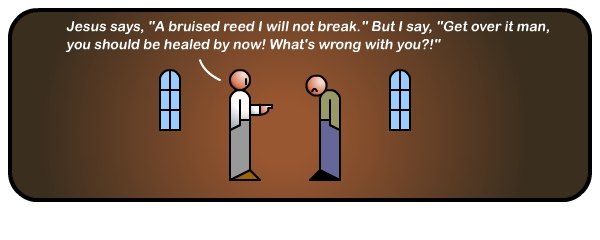
The first is to my mind an avoidance of the true message of Francis. He identified with the poor, he was an evangelist, he had a radical spirituality. He reached out to the Muslim world. The birdies were a very small and frankly insignificant part of his work, but we go for it because it's "nice". Likewise Harvest: we enjoy singing "We plough the fields and scatter" et al when most of us don't even dig an allotment and our harvest is less the fruit of our toil than it is our carbon footprint writ large. That said, I fully endorse the wisdom of an annual reflection on the creation and God's goodness: I just wish it wasn't tied up with the Percy Dearmer-esque trimmings. The Edwardian Victorian knitted chasuble movement that was Christian Socialist with the Wareham Guild and English folk dance leaves me unmoved. The revival of harvest that exuded from that seems less than relevant to me today than ever it has. So I was happy to have a reflection on Jesus's teaching on divorce. From a curate just back from his honeymoon! Oh, the irony!

Saturday, 3 October 2009

Saturday night at the Steamie.

Tonight I went out with friends and we saw Tony Roper's marvellous comedy "The Steamie". I've seen it on TV but live on stage it was truly excellent. I haven't laughed out loud so often for ages at the antics of 4 Glesca wimmin doing their washing at an old public washouse in Glasgow in the 50's. It was dated by references to Tony Curtis being good looking and the brave new all mod cons housing estate in the country to which the youngester aspired - Drumchapel!!! (For non Weegies, Billy Connoly famously described the "Drum" as "a desert wi windaes") It was great fun and 1st class.

Splendidly, the Blue Brazil beat Stenhousemuir 2-0 which sneaks them nicely up the league table. I am well chuffed as we tended not to do well against them last year. Quite an enjoyable Saturday really.

Friday, 2 October 2009

A Spiritual Exercise.

Whilst trawling online, I came across this excercise (thanks to the RevGalpals blog) and I thought it worthwhile to do it for my own entertainment. And possibly for the world's enlightenment.

Where do you find God's peace and presence, is there:

1. A place that holds a special memory?


Has to be Iona. Top of Dun I at midnight, not a cloud in the sky and moonlight bright enough to see Jura and walk downhill without a torch

2. A song that seems to usher you into the Holy of Holies?

"Be thou my vision" and "Be still, for the presence of the Lord"

3. A book/ poem/ prayer that says what you cannot?

H.A. Williams "Some Day I'll find you"

4. How do you remind yourself of these things at times when God seems far away?

Pray silently. If I'd remembered to do that more often I wouldn't in my present pickle!

5.Post a picture/ poem or song that speaks of where you are right now in your relationship with God...

Holy Sonnet XIV by John Donne

Batter my heart, three-personed God; for you

As yet but knock, breathe, shine, and seek to mend;

That I may rise and stand, o'erthrow me, and bend

Your force to break, blow, burn, and make me new.

I, like an usurped town, to another due,

Labor to admit you, but O, to no end;

Reason, your viceroy in me, me should defend,

but is captived, and proves weak or untrue.

yet dearly I love you, and would be loved fain,

But am betrothed unto your enemy.

Divorce me, untie or break that knot again;

Take me to you, imprison me, for I,

Except you enthrall me, never shall be free,

Nor even chaste, except you ravish me.

We did this in SYS English in 1984 and it has stayed with me ever since.

Anyone else fancy a go?

Dogma a bad idea?

bruisedreed

I just rather liked this: it made me smile:-)

The real evidence is not practically speaking in scholarship but in how Jesus and the Christianity based on him manifest themselves in the lives of practising Christians. Their lives are the proofs of their beliefs. Lionel Blue

As a very head down sort of thinker, I find this little bit of wisdom from my favourite rabbi very challenging. We prove our truth by living it. Credal affirmation, theolgical orthodoxy - not as important as the living evidence of lives lived in Christ. I agree up to a point. But the "theology" we believe (and by that I don't mean what is written down in books by Rowan Williams et al) is what shapes, influences, inspires and defines our living. In others words, you cannot have a dogma free Christian faith. You live what you belive about Jesus - your Christology. Your committment to parish and denomination reflects your ecclesiology (theology of Church). If you are working to bring a Christian vision into being through your social action, that is a reflection of your eschatology - your vision of what the Kingdom is like.

The proof of our belief is certainly seeing the reality of transfigured lives, especially our own. But it is impossible to have a transfigured life without a theology. And I'd rather people have a reasoned, reflective one lest the lunatics take over the Christian asylum. So I'd argue that a scholarship approach informs the life lived for Christ and it is a fallacy to imagine we can skip it totally and just live as Christians. The ultimate proof of a life lived in Christ is a life that in thought word and deed reflects the living Christ - and that includes our brains.

Thursday, 1 October 2009

Therese of the Child Jesus

https://blogger.googleusercontent.com/img/b/R29vZ2xl/AVvXsEhIHJBeIiewkDdZd7CtzsRLZChCGAS4WptbY8dgzt3hsr8MqD1AC4yO0t0XvlK6XsYVwhYLiE11zLKGQHDOajiEYSYRT7AzjQlNGJsDLyw6Xu3inYs3pzXTR_9rkiR1bxMMCAcKTdEW8so/s400/therese14.jpg

I have mixed feelings about the "Little Flower". Though I must say it's not her fault. The saccharine quality of some of the devotion surrounding her leaves me terribly cool. I blame the Victorians. In her own writings, Therese comes through quite differently.

"When I had looked upon the mystical body of the Church, I recognised myself in none of the members which St. Paul described, and what is more, I desired to distinguish myself more favourably within the whole body. Love appeared to me to be the hinge for my vocation. Indeed I knew that the Church had a body composed of various members, but in this body the necessary and more noble member was not lacking; I knew that the Church had a heart and that such a heart appeared to be aflame with love. I knew that one love drove the members of the Church to action, that if this love were extinguished, the apostles would have proclaimed the Gospel no longer, the martyrs would have shed their blood no more. I saw and realised that love sets off the bounds of all vocations, that love is everything, that this same love embraces every time and every place. In one word, that love is everlasting.

Then, nearly ecstatic with the supreme joy in my soul, I proclaimed: O Jesus, my love, at last I have found my calling: my call is love. Certainly I have found my place in the Church, and you gave me that very place, my God. In the heart of the Church, my mother, I will be love, and thus I will be all things, as my desire finds its direction."


From the Autobiography of Therese of Lisieux.

And also this snippet from the Universalis website.

What makes St Thérèse so special?

We have grown used to the idea that just as there are people with talents for sport or scholarship, and the rest of us can only admire them without trying to keep up, so there are people with a talent for holiness and heroic virtue, and the rest of us can only bumble along as best we can. We can’t do better because we’re not designed to do better, so there’s no point in trying. We sink into a consoling mediocrity.

Thérèse wrecks this. She was physically weak and psychologically vulnerable. For her the great saints were giants, they were inaccessible mountains, and she was only an “obscure grain of sand;” but she was not discouraged. St John of the Cross taught her that God can never inspire desires that cannot be fulfilled. The Book of Proverbs told her, “If anyone is a very little one, let him come to me.” If you only look, Scripture is permeated with images of our littleness and weakness with respect to God, and of his care for us in our insignificance.

Thérèse’s “Little Way” means taking God at his word and letting his love for us wash away our sins and imperfections. When a priest told her that her falling asleep during prayer was due to a want of fervour and fidelity and she should be desolate over it, she wrote “I am not desolate. I remember that little children are just as pleasing to their parents when they are asleep as when they are awake.”

Today, Therese's relics are on a tour of England and Wales. Again, venerating relics leaves me very cool indeed (the forearm of St Francis Xavier in the Gesu in Rome really made me squirm), but the very fact that on her this her Feast day they are in the great Anglican Cathedral of York Minster and that pilgrims are thronging there is truly marvellous. After a long chill in Anglican RC relations, it is good to feel a bit of a thaw. Perhaps that thaw is due to the moves of the ABC to bring about a more centralised Anglican Communion through Covenant and Instruments. Which poses the interesting question: "Does the end of Unity justify a means which changes the essential nature of Anglican Polity?" With my Anglo-Papalist leanings, I feel a degree of division in my own mind about all this. Unity yes, but Rome has to budge too. It cannot be totally about conforming to her. That is Conversion, not the convergence Geoffrey Fisher suggested to John XXIII.

But Therese remains a reminder ultimately to me of the truth of the Magnificat:

My soul proclaims the greatness of the Lord,
my spirit rejoices in God my Saviour;
he has looked with favour on his lowly servant.

From this day all generations will call me blessed;
the Almighty has done great things for me
and holy is his name.

Therese of Lisieux, pray for us.